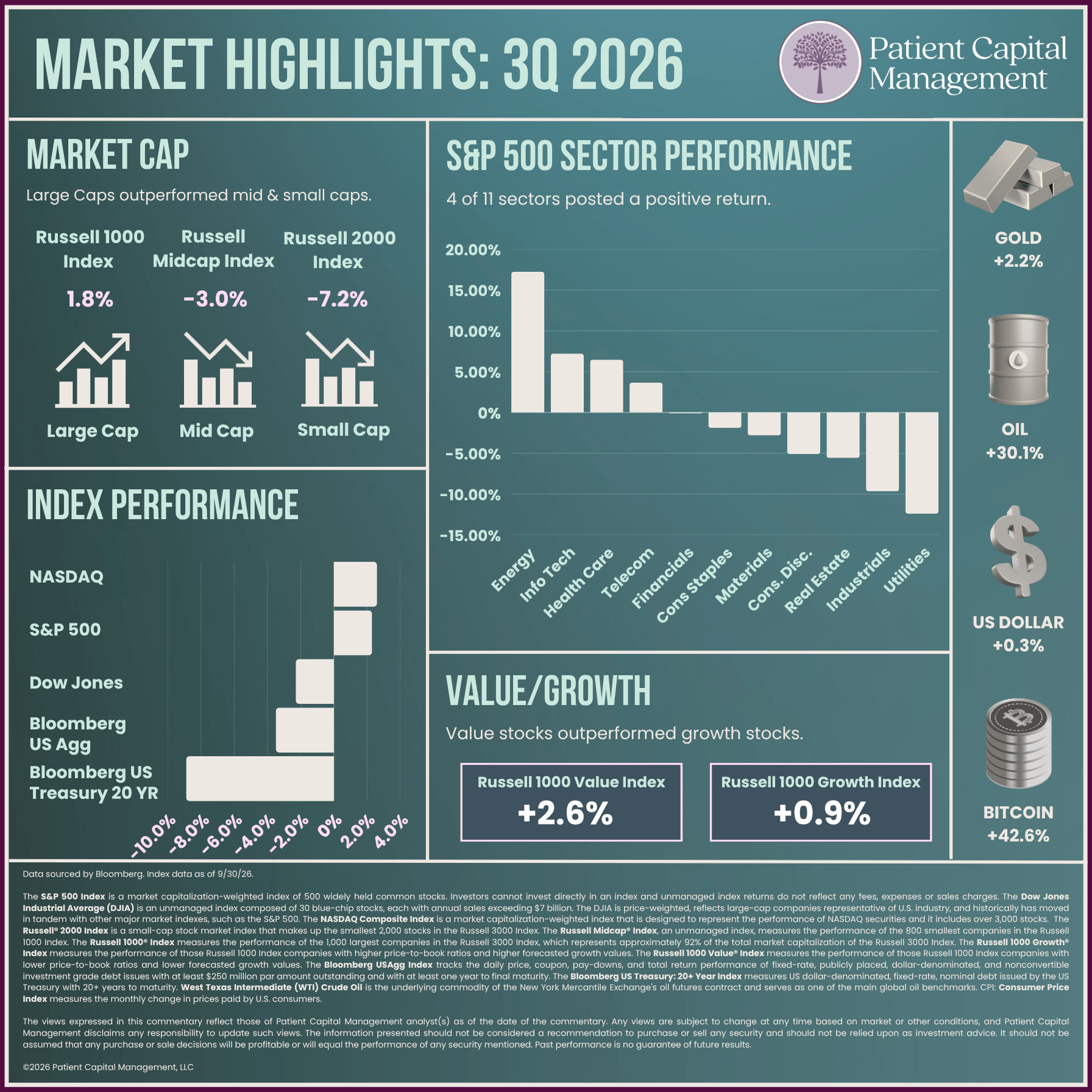
The third quarter of 2026 saw major equity indexes continue to move higher, with the S&P 500 gaining 2.3% and the Nasdaq Composite advancing 2.6% as both indexes reached new all-time highs during the quarter. However, gains became more concentrated as large-caps regained leadership. The equal-weight S&P 500 declined alongside small- and mid-caps, and only four of eleven sectors posted positive returns. Energy rebounded sharply as renewed escalation in the war with Iran pushed crude prices back above $100 per barrel, while diesel prices reached an all-time high in mid-September.
The 10-year Treasury yield moved above 5%, its highest level in roughly two decades. Higher yields weighed on bonds and rate-sensitive equities, including Utilities. Higher borrowing costs flowed through to mortgage rates, which moved back above 7%, adding further pressure to housing affordability as starts and permits declined in August.
Within technology, software rebounded from the “SaaS apocalypse” earlier in the year and outperformed semiconductors during the quarter. Software’s weaker year-to-date performance nevertheless remained a headwind for growth and quality strategies exposed to the group. Semiconductors pulled back following their sharp second-quarter rally but retained substantial year-to-date gains. AI remained the central market theme, with investors weighing infrastructure demand against the scale of capital spending and uncertainty about investment returns.
Inflation remains above the Fed’s 2% target rate leading to the first Fed Funds rate increase since 2023. Though August’s reading came in better than expected, with headline CPI reaching 3.4% in August, while core PCE, the Fed’s preferred underlying inflation gauge, remained at 3.0%. Meanwhile, the labor market showed signs of weakness as hiring slowed and unemployment edged up to 4.2% in September. Consumer sentiment weakened further, with the University of Michigan index falling to 48.1 in September, though the weakness has not yet translated into consumer spending, as retail sales rose 1.2% month over month in August. Nominal GDP growth also remained robust at 6.3% in the second quarter, underscoring the resilience of economic activity despite weak consumer sentiment.
Against this mixed backdrop, the Fed unanimously raised the fed funds rate by 25 basis points to ~3.75% to 4.00%, its first hike since 2023. Markets continued to price in another increase by year-end, though softer-than-expected PCE data reduced expectations for an October move.
The Nasdaq Composite led the major benchmarks, advancing 2.6%, followed by the S&P 500, which gained 2.3%, while the Dow Jones Industrial Average declined 2.3%. Four of the eleven sectors within the S&P 500 posted positive returns. Energy led, rising 17.2%, followed by Health Care and Information Technology, which returned 7.2% and 6.5%, respectively. Utilities declined 12.4%, its worst quarter since the first quarter of 2020.
Large-caps led this quarter, with the Russell 1000 gaining 1.8%, outperforming both small-caps and mid-caps. The Russell 2000 declined 7.2%, while the Russell Midcap Index fell 3.0%. Value regained the lead, outperforming growth, with the Russell 1000 Value Index rising 2.6% compared with a 0.9% return for the Russell 1000 Growth Index.
Bonds were negative and underperformed all major equity indexes in the quarter. US Corporates declined as the Bloomberg Aggregate returned -3.5%, while long-dated U.S. Treasuries fell 8.9%.
The U.S. dollar gained 0.3% during the quarter, while gold rose 2.2%. West Texas Intermediate (WTI) surged 30.1% as tensions in the Middle East reignited, bringing its year-to-date gain to 57.5%. Bitcoin snapped its three-quarter losing streak, rallying 42.6% to end the quarter at $83.6K.