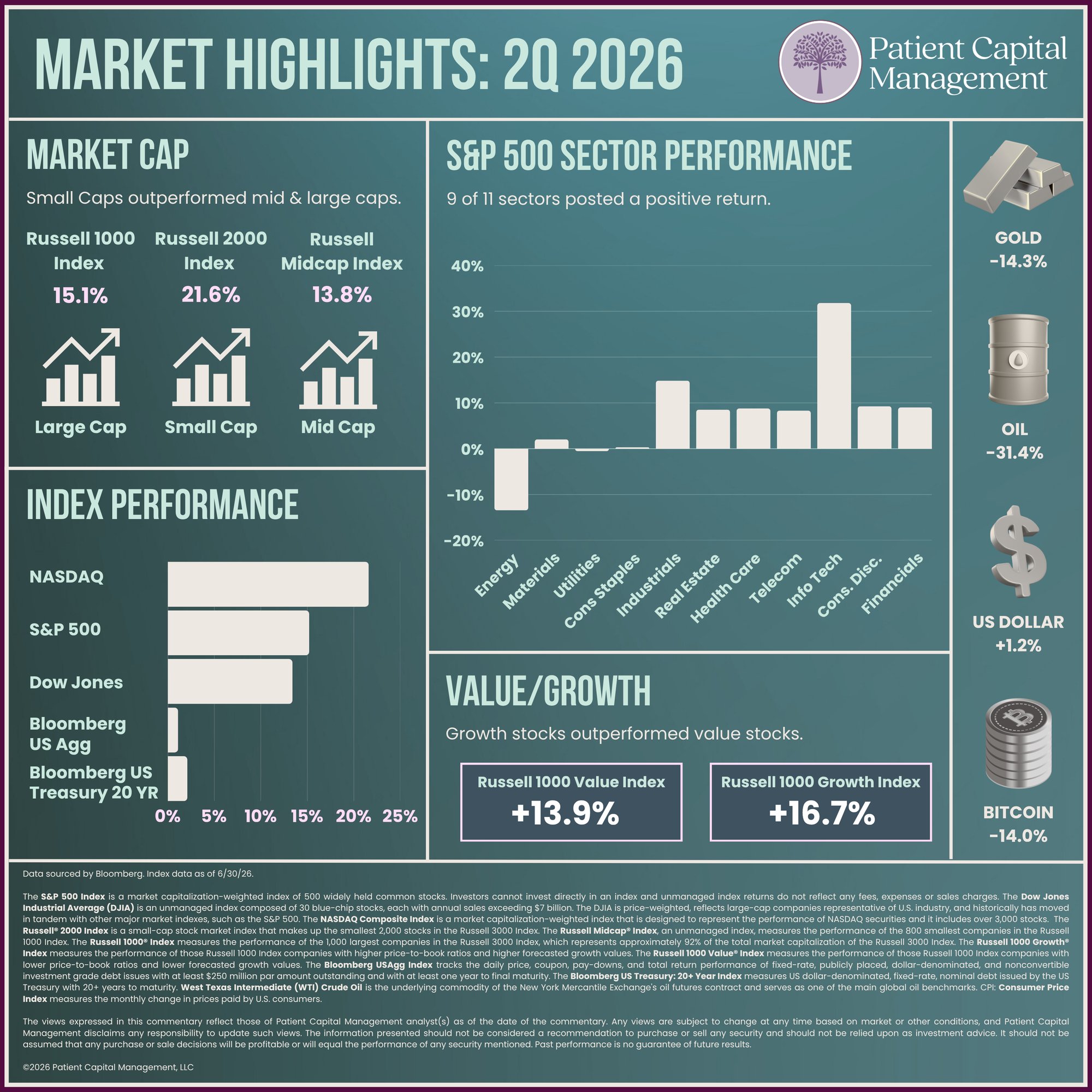
The second quarter of 2026 marked a sharp reversal from the first quarter's decline. The S&P 500 returned 15.2%, its 12th best quarter since 1950 and its strongest since the pandemic rebound in Q2 2020. The rally was led by AI and technology, with semiconductor stocks at the center of renewed enthusiasm for the AI trade. The Nasdaq gained 21.6%, while semiconductors posted a record quarterly return of 88.0%. Easing tensions from the Iran War helped fuel the recovery, as oil prices fell back to pre-war levels.
Despite the relief, the macro backdrop remains complicated. Headline CPI rose to 4.2% in May, the highest reading since 2023, while core PCE, the Fed’s preferred underlying inflation gauge, increased to 3.4%. At the same time, the labor market remained resilient, with unemployment holding near 4.3% through May and initial jobless claims inching up to 215k in June. Consumer sentiment remained weak, falling to a record-low 44.8 in May before rebounding to 49.5 in June, still an exceptionally depressed level. The weakness in sentiment has not translated into weaker spending, with retail sales rising 0.9% month over month in May.
The Fed remains in a difficult position as economic signals continue to conflict. Kevin Warsh chaired his first FOMC meeting and emphasized the Fed’s commitment to price stability while removing much of the forward guidance investors had grown accustomed to under prior regimes. The Fed held rates steady at 3.50% to 3.75%, but markets focused on the updated dot plot, which showed a meaningful shift toward additional tightening by year-end.
All major equity indices reached new all-time highs during the quarter. The Nasdaq Composite led the major benchmarks, advancing 21.6%, followed by the S&P 500, which gained 15.2%, and the Dow Jones Industrial Average, which rose 13.4%. Nine of the eleven sectors within the S&P 500 posted positive returns. Information Technology led, surging 31.8%, followed by Industrials and Consumer Discretionary, which returned 14.9% and 9.3%, respectively. Energy gave back some of its first quarter gains declining 13.4% as crude oil prices softened.
Small-caps led this quarter, with the Russell 2000 gaining 21.6%, its 8th best quarter since inception, outperforming both large-caps and mid-caps. The Russell 1000 rose 15.1% and the Mid-Cap Index posted returns of 13.8%. Growth regained the lead, outperforming value, with the Russell 1000 Growth Index rising 16.7% while the Russell 1000 Value Index returned 13.9%.
Bonds were positive but underperformed all equity indexes in the quarter. Long-dated US Treasuries returned 2.1% followed by US Corporates with the Bloomberg Aggregate returning 1.1%.
The U.S. dollar gained 1.2% during the quarter, while gold fell 14.3%, breaking below its 200-day moving average for the first time since the third quarter of 2023. West Texas Intermediate (WTI) pulled back 31.4% but remains up 21.0% year-to-date. Bitcoin extended its losing streak to three consecutive quarters, falling 14.0% to end the quarter at $58.6k.
Data sourced by Bloomberg. Index data as of 06/30/26.